In the global shipping industry, over 90% of disputes are resolved through Maritime Arbitration, predominantly in London under the LMAA (London Maritime Arbitrators Association) terms. However, winning an arbitration award is only half the battle. For a foreign creditor, the ultimate goal is the enforcement of that award against the debtor’s assets, which often involves […]
The legal framework governing the protection and preservation of the marine environment represents one of the most sophisticated aspects of modern maritime law. Under the 1982 United Nations Convention on the Law of the Sea (UNCLOS), the traditional absolute freedom of the high seas is curtailed by the necessity of environmental stewardship. Central to this […]
Securing insurance payments after a maritime casualty (such as a collision, grounding, or fire) on the high seas is not an automatic administrative process; it is a rigorous legal battle. For a shipowner to successfully recover their losses, the preparation of the compensation claim must be executed with technical precision and backed by undeniable legal […]
The Right of Hot Pursuit is one of the most remarkable exceptions to the principle of “Flag State Sovereignty” on the high seas. While the high seas are traditionally an area of total freedom, the 1982 United Nations Convention on the Law of the Sea (UNCLOS), under Article 111, provides coastal states with the authority […]
The legal regime of the territorial sea represents a delicate compromise in international maritime law. While a coastal state exercises full sovereignty over these waters, it must balance its domestic laws with the international right of innocent passage. The exercise of criminal jurisdiction in this zone is not absolute; it is governed by a framework […]
Definition, Legal Nature, and Turkish Supreme Court Practice I. Introduction Maritime trade, an inherently international and high-risk sector carrying a significant portion of global trade volume, relies heavily on the charterparty (contract of carriage by sea) as one of its fundamental agreements. In the Turkish Commercial Code (Law No. 6102, “TCC”), maritime trade is regulated […]
Introduction International logistics is one of the most critical elements of global trade. However, cross-border transportation is not only an operational process but also a multi-layered activity subject to both national and international legal rules. Every stage of the logistics process is directly related to customs regulations, carriage contracts, international conventions, and local laws. 1. […]

Introduction The complex structure of maritime transport and the unpredictable events that may occur at sea have made maritime accidents one of the most significant risk areas in commercial activity. Maritime accidents may take the form of collisions, sinking, grounding, fire, cargo loss, and more. When such accidents occur, the ensuing liabilities and compensation regime […]
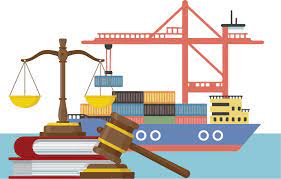
What Is Maritime Law? Admiralty law, commonly referred to as maritime law, is a particular set of rules and laws that control activities and disagreements that take place on the high seas and in navigable waterways. It covers a broad variety of legal issues pertaining to shipping, navigation, and marine resources. To control operations in […]