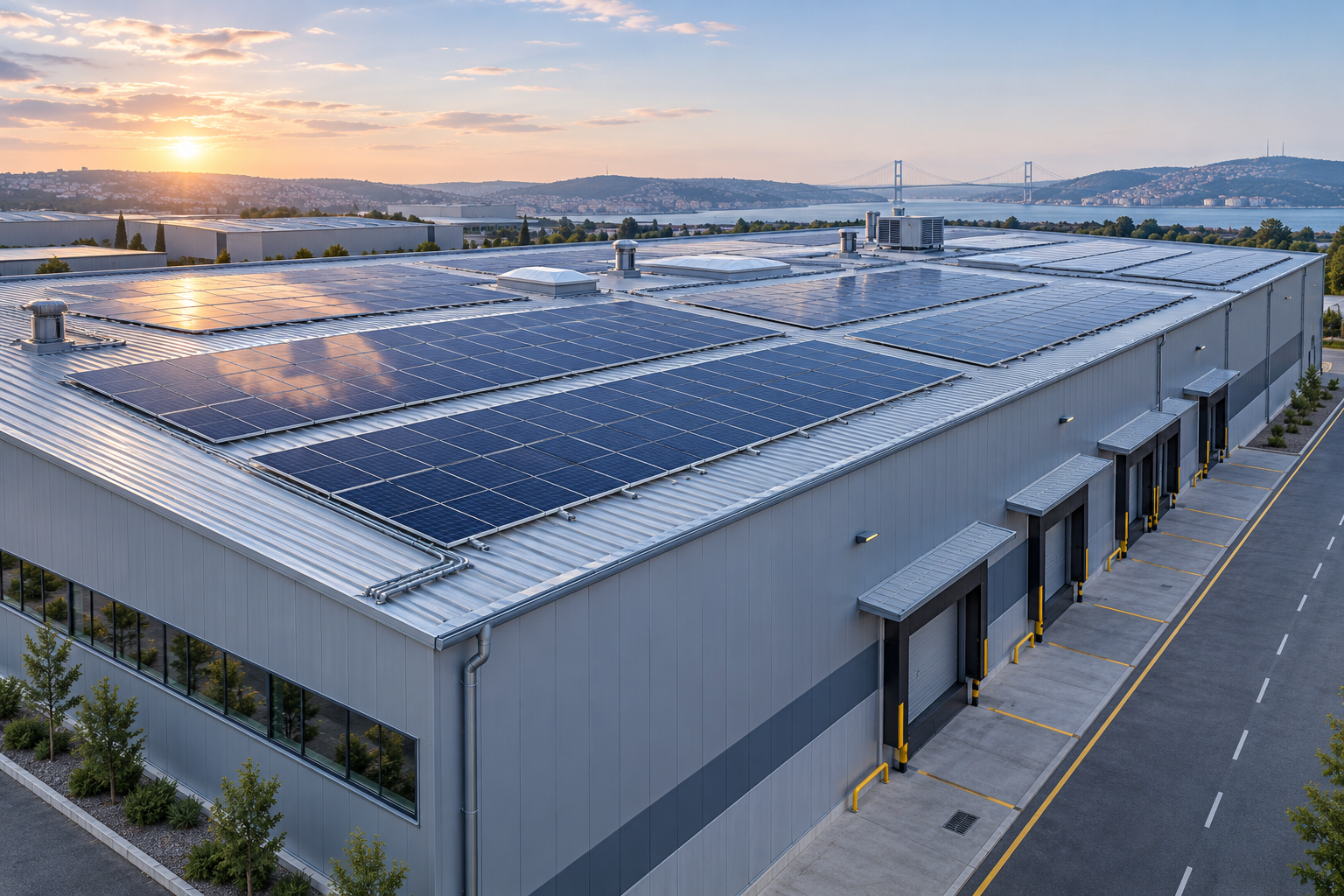
A logistics tenant in Türkiye may have an excellent roof, a willing landlord and a convincing proposal for reducing its electricity bill. None of those answers the three questions that determine whether the project can proceed: who has the right to use the roof, whose consumption the generation will serve, and what happens to the equipment and electricity arrangements when the tenant leaves. Resolve all three before making a non-refundable equipment commitment.
This guide looks at a grid-connected warehouse project whose business case is principally self-consumption. It focuses on the decisions a tenant, property owner and investment committee need to make together, rather than the engineering design or a universal licence-exemption formula. An installation at a privately owned single-tenant warehouse and one at a shared industrial site can present different facts, even if the same installer quotes both jobs.
1. Make sure the right landlord can say yes
Article 321 of the Turkish Code of Obligations requires the landlord’s written consent for a tenant to alter or improve the leased premises. The provision also separates two matters that commercial parties often bundle together. A consenting landlord generally cannot demand reinstatement unless it was agreed in writing. Conversely, a tenant generally cannot claim the resulting increase in the property’s value unless a written agreement provides otherwise. Agree expressly on both points; the fact that a system cost money is not a compensation formula.
Read the lease’s plan, not just its address. Premises may be described by internal floor area while roof, plant rooms, cable shafts and exterior access remain reserved. Obtain a plan marking the installation footprint, inverter and switchgear locations, cable routes, access points and any temporary construction zones. If the consenting party is itself a tenant, a property manager or one of several owners, establish what it can authorize and obtain the signatures that bind the relevant rights holders. A consent email from the facility manager may be useful evidence of coordination, but is not a substitute for establishing signing authority.
The addendum should distinguish permission to investigate, permission to install, continuing permission to operate and the right to remove. It should address access after hours, emergency shut-down authority, and what happens when the roof must be repaired. A drawing and one responsible contact on each side will often prevent more delay than broad phrasing such as “the tenant may install solar panels.” If a condominium, superior lease, mortgage or project-level covenant is involved, review the actual documents before assuming a separate consent is or is not needed.
2. Map the roof, meter and applicant as separate items
Put four names or identifiers on a one-page diagram: the property owner, the proposed generating entity, the entity named on the relevant consumption account, and the relevant network operator. Then trace each physical and contractual connection. In some warehouses the tenant holds its own subscription. In others, the property owner is billed at a main meter and allocates charges to occupants through private submeters. An internal invoice or meter reading shows use for commercial analysis; it does not establish that the occupant has an independently eligible consumption point under the chosen regulatory route.
The Energy Market Regulatory Authority (EPDK) publishes the unlicensed generation regulation, application document list and network agreement materials. Before committing money, have the project team identify the exact exemption basis it proposes and check the applicable application and connection requirements against the real site and entity structure. The relevant network operator may differ at industrial estates. Find out which operator actually serves the parcel instead of relying on the name printed on a neighbouring business’s bill.
Do not ask the installer merely whether permission is likely. Ask for the identifiers, documents and assumptions behind the proposed structure: the account or point to which the project is to be linked, the name that will appear on each application and agreement, and any mismatch with the names on the lease and invoices. A project file should distinguish preliminary feasibility feedback from formal connection documents and acceptance. The parties’ allocation of costs cannot replace the operator’s assessment, and a roof agreement cannot grant rights over the network.
If a landlord, financier or energy-services company proposes to own and operate the system while the tenant pays by kilowatt-hour, treat that as a separate structure. Identify who supplies or services whom, who carries the output risk, and how payments are calculated. A commercial label such as “equipment rental” or “energy service” does not itself establish that the arrangement fits an exemption or can be implemented under the contemplated subscription. Test regulatory and contractual feasibility before relying on its projected benefits.
3. Do not buy a system against a spreadsheet’s annual total
Obtain actual electricity bills and, if available, interval data for a representative operating period. Compare generation and demand when they occur: a weekday daytime warehouse, a refrigerated operation and a distribution centre that ramps up after dark do not have the same load profile. Account for seasonal heat, weekend closures, and the possibility that the tenant changes hours or downsizes. Ask the engineer to reconcile generation used on site, exported energy, imported energy and losses rather than putting all annual generation in one savings line.
The April 2026 amendment to the unlicensed generation regulation addresses hourly set-off. Verify how settlement and any transitional provisions apply to the specific project, including dates and configuration, together with EPDK’s implementing materials. Do not apply a universal monthly or hourly method to a facility merely from the date of a blog article. For underwriting, ask for a conservative case without unconfirmed export income, then separate upside that depends on the applicable settlement and payment rules. A warehouse can produce usable electricity and still fall short of the original return model.
Build sensitivities for reduced daytime load, temporary roof works and connection delay. If the tenant pays for output under a service contract, compare the portion charged under a minimum-payment formula with the value the tenant expects to receive. If the landlord benefits in the period after the tenant leaves, allocate the risk of interruption and establish who can claim a payment or enforce warranties in that period. Avoid using projected savings to justify an unconditional rent or equipment commitment when the operator’s position is not yet documented.
4. Turn each missing document into a commercial decision
Assign an owner and a deadline to each row of the document request. A financing committee can then distinguish matters that block the order from matters that can be finished during construction. Save the current version of the diagram with the decision, so a later change in equipment or entity is visible.
| Decision | Request | Risk | Impact on the transaction |
|---|---|---|---|
| Right to alter and operate | Signed lease, property plan, landlord consent and signing authority | Lease may exclude the roof, cable route or emergency access | Do not authorize installation before all affected areas and rights are covered. |
| Electricity account and applicant | Recent bills, subscription record, meter and applicant details | The tenant’s submeter may not identify the formal subscription | Resolve the entity and connection route before underwriting savings. |
| Grid connection and eligibility | Operator correspondence, application package and relevant agreements | Feasibility may be provisional or conditional | Link the equipment order and payment dates to specified evidence. |
| Roof condition and continuity | Structural assessment, baseline photos, warranties and repair plan | Installation can complicate repairs, waterproofing and access | Budget for interruptions and assign removal and reinstallation costs. |
| Exit and transfer | Lease addendum, equipment and financing contracts, handover plan | End of tenancy may strand equipment or interrupt operations | Specify removal, buyout or transfer, with clear dates and obligations. |
Put foreseeable extra costs in the project budget, even if the assignment of liability remains under negotiation. If the building already needs a roof replacement, for example, record who funds the underlying works separately from removal and reinstallation of the panels. Define what evidence is required for any claimed damage: baseline photos, inspection results, incident reports and contractor records. That evidence is cheaper to assemble before scaffolding goes up than after the first leak.
5. Sign in stages and negotiate the exit before the start
Consider a feasibility stage with a capped budget and permission for non-destructive investigation. Make the order or notice to proceed conditional on the specified written roof rights, confirmation of the workable network route and the required commercial documents. Decide exactly which deposits are refundable or transferable if a condition fails. A bald “subject to approvals” clause leaves both parties guessing about which approval, by what date, and what happens to money already spent.
Use a construction schedule that acknowledges the building remains in service. Allocate the roof warranty interface and require the contractor to coordinate with the property’s maintenance team. Document how protective equipment, penetrations and isolation points will be accepted against the approved design. A payment milestone tied only to physical delivery is different from one tied to installation, regulatory acceptance or documented operating performance. Match milestones to evidence rather than to a calendar alone.
For expiry, early exit or a building sale, compare removal, retention and transfer. If removal is chosen, specify who pays, who restores the roof and how long the outgoing tenant can get safe access after surrender. If the owner will retain the equipment, agree the valuation or pricing mechanism, documentation, warranty assignment and the treatment of outstanding claims. If a replacement tenant is expected to keep using the system, separate property access and equipment transfer from any operator-facing changes. Do not assume either the subscription or the generation arrangement follows the keys to the building.
A sale adds another layer. Article 310 of the Code generally makes the new owner a party to the lease after a transfer, subject to its stated qualification. That does not by itself answer whether a separate equipment lease, financing agreement or service contract moves with the property. Check which terms form part of the lease, which bind a separate entity, which notices and consents are needed, and whether handover can occur without interrupting operation. Put usable copies of drawings, contracts and acceptance records in the property handover file.
A worked example: a warehouse with a shared electricity account
Suppose a cold-chain tenant has five years left on its lease and the installer bases a proposal on the refrigeration load. The property owner says the tenant pays for the energy and therefore can claim the expected savings. The bill, however, names the landlord; the tenant’s charges appear only in a submeter reconciliation. The owner also plans to replace part of the roof in year three. These facts affect both who can participate and how much the work is worth; neither is solved by choosing a smaller array.
A sensible sequence would be to obtain the single-line diagram, subscription details and operating data; record the proposed applicant and consumption point; ask for a project-specific assessment of the route; then price roof replacement and outages into the downside case. In parallel, draft a consent with marked access and responsibility for roof works. If the model depends on a separate subscription, the team should not count the savings until the requirements and implementation cost of that change are known. If the plan depends instead on the landlord’s account, check how the arrangement would lawfully work and how the tenant’s bill reductions can be verified. Either way, agree an end-of-lease outcome before the order is released.
Checklist before releasing the equipment order
- Confirm the signatories and mark the roof, installation, access and cable areas on a plan.
- Obtain the lease addendum and any separate approvals identified in property due diligence.
- Confirm the applicant, the consumption point, the network operator and the proposed regulatory route.
- Review connection conditions, approval dependencies and the commissioning and acceptance sequence.
- Cross-check the investment case with operating data and stress-test it without unconfirmed export revenue.
- Agree capped feasibility spending, deposit treatment and conditions to release the equipment order.
- Assign roof repairs, installation damage, insurance, outage risk and ongoing maintenance.
- Record what happens to the equipment, subscription arrangements and roof at exit or sale.
Frequently asked questions
Is a landlord’s signed permission enough to install and connect?
No. Written consent addresses the landlord and tenant relationship and must actually cover the planned works and areas. Regulatory, network, technical and other property constraints have to be checked separately. Match the written permission to the final scope and determine whether amendments to the drawings need further approval.
Can the landlord insist on reinstatement or keep the panels without paying the tenant?
Those are separate questions, and a generic consent is a poor substitute for clear drafting. Article 321 provides the starting rules on reinstatement and compensation for increased property value. Title to particular equipment, removal rights, reinstatement obligations and any buyout depend on the contracts and other applicable law. Address each explicitly rather than relying on the tenant’s assumption that the equipment is removable or the owner’s expectation that it is part of the building.
Should the system size follow the full roof area?
Size the project against physical constraints, anticipated consumption and the applicable regulatory and network position. A roof may support a larger system than the business can use economically under its operating profile. Conversely, an apparently small array may be hard to justify when roof access, reinforcements or a short remaining lease dominate the cost. A smaller pilot is useful only if it can be built and operated lawfully and if its cost still makes sense on its own.
Will a new tenant automatically inherit the savings?
No assumption of automatic continuity should go into the model. The new occupant’s electricity account, the project’s contractual configuration and any required regulatory steps must be checked. Ask who can operate, receive the benefit and arrange maintenance during any vacancy. Document the answer if a property sale or tenant replacement is a planned part of the investment case.
Official sources
- Turkish Code of Obligations No. 6098, Articles 310 and 321.
- EPDK: unlicensed electricity generation materials, including application, agreements and settlement documents.
- Official Gazette, 2 April 2026 amendment to the unlicensed generation regulation.
This guide is general information. The applicable electricity route and property rights depend on the facility, its agreements, and its regulatory and connection history.
No Responses